Surrounded, but Not Nourished
What we lost when we lost boredom

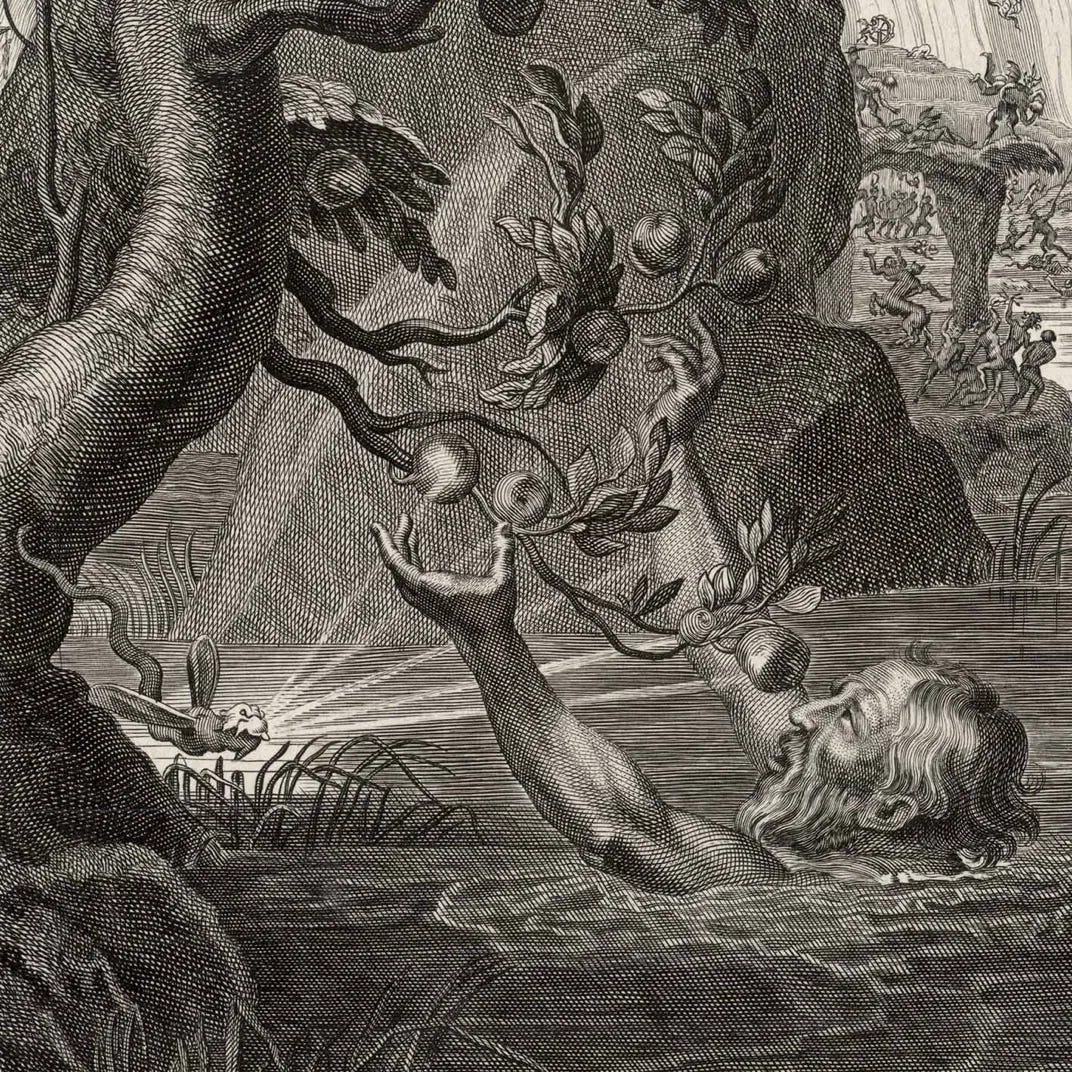
We have all heard the story of Tantalus. A king who stood in a pool of water, fruit hanging just above his head. Every time he reached, the branches pulled away. Every time he bent to drink, the water receded. He was not starving in an empty room. He was surrounded. That was the punishment.
This is not an ancient story. It is the architecture of the present.
We are not lacking. We are surrounded. And yet something keeps receding, not the content, but the nourishment. We consume more than any generation before us and somehow leave the table hungry.
We are exposed to more and more, while less and less actually happens around us. Information does not lack. It floods. And yet something is missing, not knowledge, but processing. We no longer take in experience and make it our own. We witness it. All emotions are satisfied with catharsis by proxy. All the thirst for knowledge and thoughts is quenched by a constant information stream. We know things we don’t understand. Consider what that looks like. A person reads about a war and feels informed. They have not lost anyone. They have not heard a single sound. But they carry an opinion about it, perhaps even a strong one, shaped entirely by things they have scrolled past.
Thought is no longer produced. It is carried, as if we are a conveyor belt. Our thoughts, virtues, and even emotions arrive preformed. Even when we watch a movie, we feel the need to watch someone else explain what we have just seen, as if our own experience were insufficient. We no longer trust our capacity, or rather, we have begun to deny that we possess such a capacity at all. And in doing so, we hand over the one thing that could actually be called ours.
Personalization deepens the illusion. It makes us feel seen, understood, even unique. But what feels like individuality is often dictated. We are not choosing what we see, we are being shown what to see. If my music catalog is mostly viral songs, is it really mine? The system does not oppress by saying no. It oppresses by saying yes so relentlessly that we never develop the capacity to say no ourselves.
This produces a subtle shift in how we exist. We move from actors to spectators of life.
To witness is to remain at a distance, to observe without consequence or responsibility. But individuality cannot emerge at a distance. It requires involvement. It requires risk. It requires stepping into the scene rather than watching it unfold.
Here, we must be honest about who is responsible. It’s comforting to say that the age has done this to us, that the architecture is to blame. And the architecture does matter. It’s designed, intentionally, to keep us engaged. On the other hand, no one forces the hand that reaches for the phone at 2 am. No one compels the second hour of scrolling after we have already decided to stop. Every time we choose not to sit with a thought, not to stay with discomfort, not to let a silence remain unfilled. The system provides the ocean, and we chose to remain in it.
We must move from viewer to actor. But becoming an actor does not begin with action. It begins with something quieter: stopping.
One does not find oneself by exposure to more information, but by staying with what is already there. To process is to remain with an experience long enough for it to take shape, to resist the urge to move on before anything has settled.
This is precisely what our age makes difficult.
We have lost boredom. Not as an inconvenience, but as a capacity. The ability to sit with an experience long enough to internalize it. We treat boredom as a problem to be solved, a gap to be filled. But a gap that is always filled never becomes a space. And without space, nothing settles. Nothing becomes yours.
What does this mean in practice? It means the walk that cannot happen without earbuds. It means the waiting room must be filled with a screen. It means we must attend the social gathering even though we don’t like that specific activity. It means midnight pee breaks are accompanied by social media. Each instance, taken alone, is nothing. Taken together, they constitute a life in which no interval is permitted to be empty and therefore no interval is permitted to become anything.
Byung-Chul Han calls this hyperattention. (Han 13) Not a personal failure, but a structural condition. We have traded contemplative attention for vigilance, the ability to go deep for the ability to scan wide. Han reminds us that multitasking is not civilizational progress, it is what wild animals do to survive. An animal eating must also watch for predators, guard its young, monitor its surroundings. It cannot immerse itself in anything because everything demands equal attention at all times. We have built a world that asks the same of us. Yet animals have to do this to survive. We do it to amuse ourselves. Even we make movies that you can “watch” while scrolling on your phone these days. “Show, don’t tell” quietly turns into “tell, because no one is really watching.”
And what we lost was not one thing, but two. We lost the deep, contemplative attention that made philosophy, art, and science possible, the kind that stays with something long enough to transform it into understanding. And we lost something quieter: the ability to simply be present to what is immediately around us.
Simone Weil describes attention as a mind that is empty, waiting, not seeking anything, but fully available to what is in front of it. (Weil 62) Not forcing a reaction. Not reaching for an interpretation. Just present enough that everything can land: the laugh of a friend, a thought that surfaces unexpectedly, the feeling a scene produces before you have named it.
This is not the frantic scanning of hyperattention. It is almost its opposite. Hyperattention is like a pair of binoculars, it zooms toward what it is pointed at and closes off everything else. It creates a feeling of importance and urgency by bringing far-off things close to us. Weil’s attention puts the binoculars down. Suddenly, what is close becomes visible again.
Weil calls this emptying. But emptying is not erasure. When you strip away the borrowed opinions, the secondhand reactions, the noise that was never yours. What remains is not nothing. What remains is you. The self that responds before it calculates. The self that moves toward what it sees without first asking whether it should.
Weil’s life makes this visible. When she heard about the alienation of factory workers, she did not write a paper like her peers. She went to work in a factory. When she felt drawn to Christianity but could not accept the Church’s exclusions, she refused baptism, not out of doubt, but out of fidelity to what she actually felt. When Simone de Beauvoir met her and was unsettled, it was not because Weil was brilliant. It was because Weil wept when she heard about a famine in China. That response was not intellectual. It was not performed. It was simply, entirely, hers.
This is what individuality actually looks like. Not having unique thoughts. Not cultivating an interesting mind. But responding to reality in a way that is fully your own, even when that response costs you. Especially when it costs you. Weil chose discomfort to understand the world. She chose exclusion to remain honest. She lived what she saw, instead of buffering it with abstraction. Every act was hers because every act came from something she had attended to deeply enough that it had become part of her.
Both kinds of attention require the same thing: that you have stopped long enough to actually be present. In this sense, boredom is not a state of inactivity, but it is the prerequisite to both thought and response. It’s putting a limit on numbing exposure.
True freedom is not the absence of limits. It is the presence of chosen ones. To become an individual is not to expand what you can do. It is to clarify what you want. Saying no to what doesn’t matter means saying yes to what matters.
We are not sentenced like Tantalus. The ocean we stand in is not imposed on us.
Perhaps the first step is smaller than we think. Not leaving everything behind, but stepping out, even slightly. Finding a place where something can actually stay. It takes very little to interrupt this. A pause. A moment where nothing is filled. Where attention is not pulled away. In that space, something begins to take shape. Not everything at once, but something. And for the first time, it can become truly yours.
The movement is not grand. It is simple. It is staying when you would rather move on. It is choosing when everything is available. It is holding onto something long enough for it to become yours.
Individuality does not begin with a grand act. It begins the moment you respond to something with your whole self, and discover that the self was there all along, waiting beneath the noise.
Works Cited
Han, Byung-Chul. The Burnout Society. Translated by Erik Butler, Stanford University Press, 2015.
Weil, Simone. Waiting for God. HarperCollins, 2000.